A private landowner needed to know what a large plot near Jõhvi — strategically positioned on the Tallinn–St. Petersburg axis, near the future Rail Baltic line — was actually good for, before committing to a design direction. SPIN Unit’s team joined architecture practice Ars Projekt to bring quantitative rigour (accessibility, suitability, and space-syntax analysis) to what would otherwise have been a purely design-led concept study.
Ida-Virumaa’s economy centres on oil shale mining and heavy industry, with a target population base of roughly 150,000 people around Jõhvi. At the time, the local market showed no available rental housing or business space, at prices below the Estonian average — the analysis had to make a case for what kind of development this specific, regionally strategic but locally disconnected site could support.
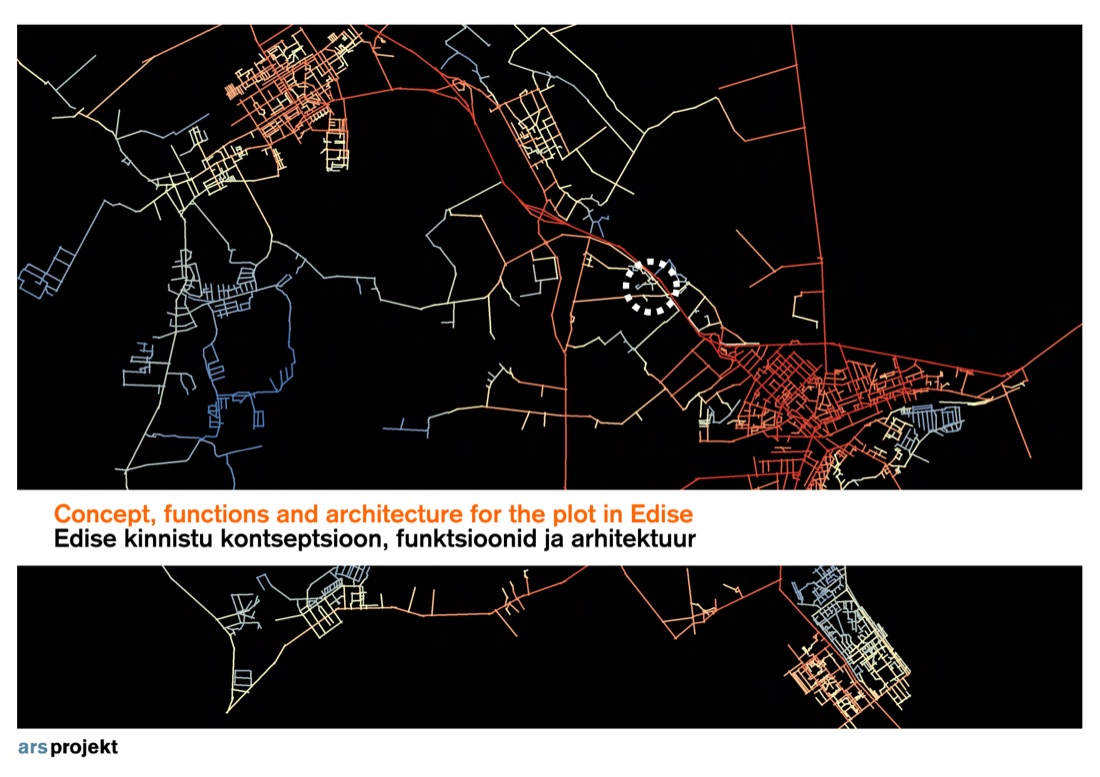
The team combined historical/statistical site analysis with three quantitative layers: Multiple Centrality Assessment (regional and local street-network accessibility), a suitability overlay comparing centrality, infrastructure proximity, and environmental/technical constraints, and space syntax analysis (Choice and Integration, existing vs. proposed network). These fed into four development scenarios — trade-fair/mixed-use, industrial, educational, and mixed housing — each tested with alternative sketch plans and density figures (FAR, floor area, building coverage).
Delivered as a single design-and-analysis engagement (January 2013), producing a 51-page bilingual concept report alongside a dedicated accessibility-analysis deck and a planning report with density calculations per scenario.
 Open full size ↗