← All projects/Space/No. 15
2017 · Space · University of Salford

MediaCityUK Activity Analysis

Comparing what MediaCityUK offers against what people actually do there, using Foursquare venues as “supply” and Instagram/Twitter activity as “demand” across Greater Manchester.
MediaCityUK Activity Analysis

MediaCityUK was built as a new media and cultural quarter for Salford — but does its amenity mix match how people actually use the area day to day? This study set supply against demand to find out.

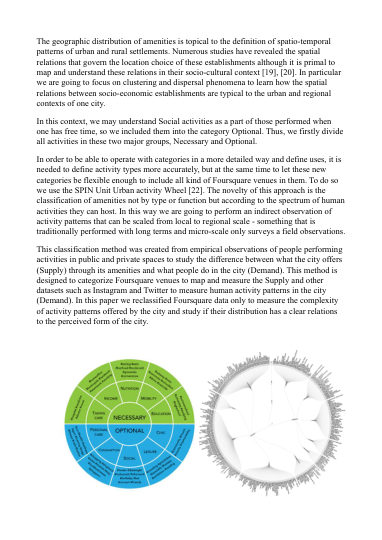
A research collaboration with the University of Salford, using SPIN Unit’s “Urban Activity Wheel” classification (Necessary/Optional activities across ten categories) applied consistently across Greater Manchester so MediaCityUK could be benchmarked against the wider city region.

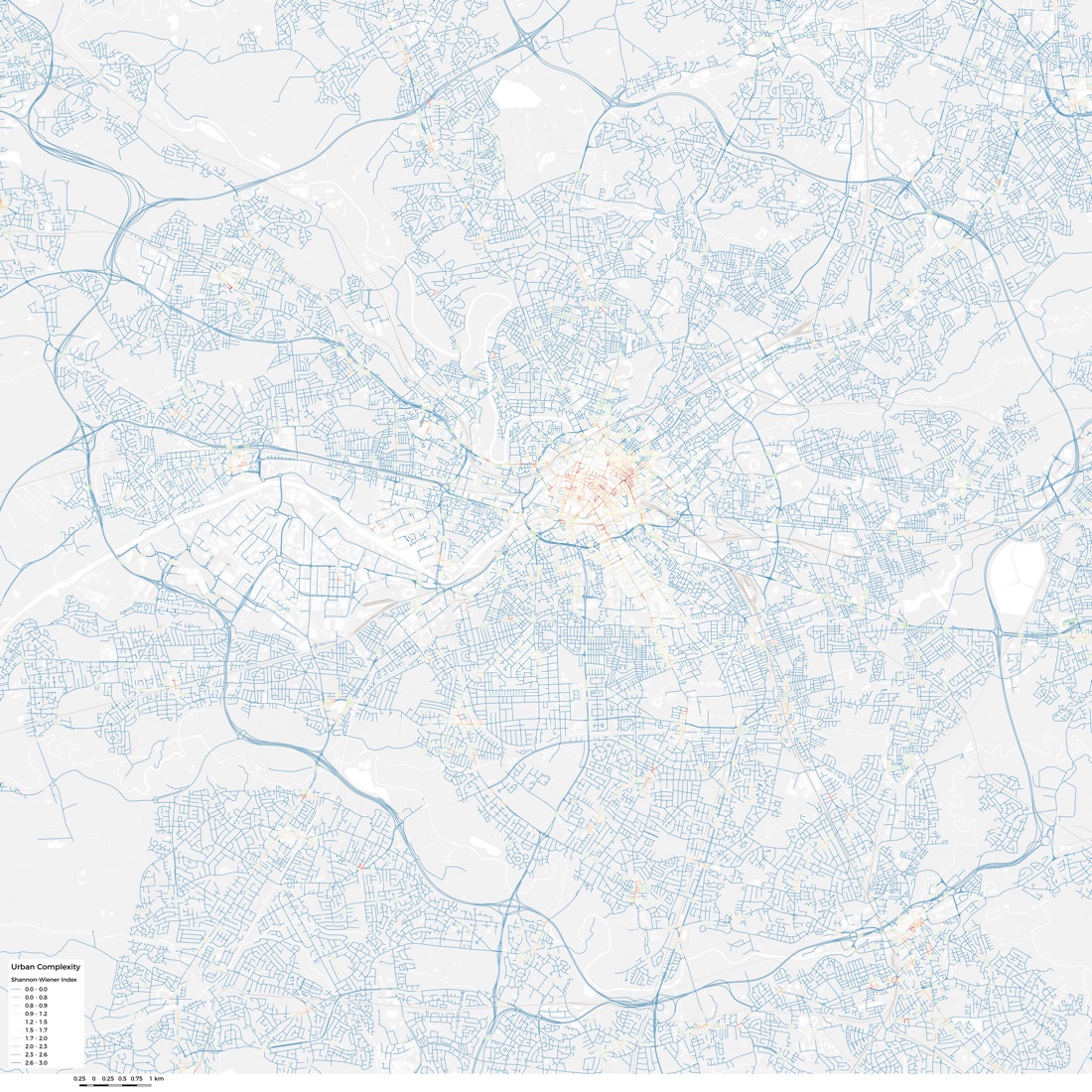
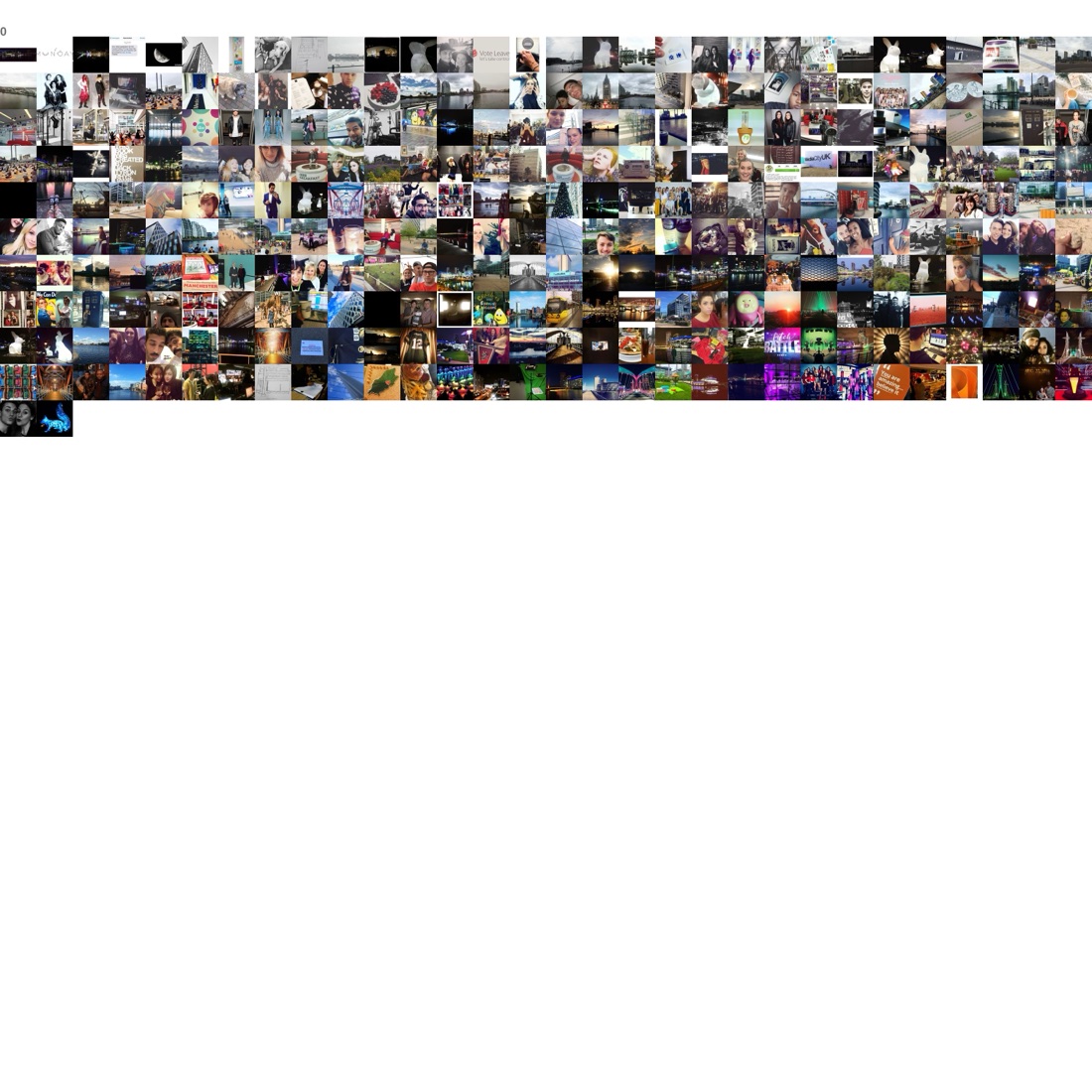
Foursquare venues (supply) and roughly 9,200 geotagged Instagram photos plus Twitter activity (demand) were both classified into the same ten-category framework. Accessibility was measured via network-distance isochrones at 400m, 600m, 1200m, and 6000m per category, and urban complexity was scored with a Shannon-Wiener diversity index — an ecological measure borrowed from prior academic use in studying Spanish tourism cities.

A short-turnaround research brief (summer 2017), explicitly noted in the report as data-collection-limited to the summer period.
1 report to download
About the project
ClientUniversity of Salford
PlaceSalford / MediaCityUK, Greater Manchester, UK
Year2017
LensSpace
TopicsAccessibility, Social Media Data, Urban Complexity
What we found
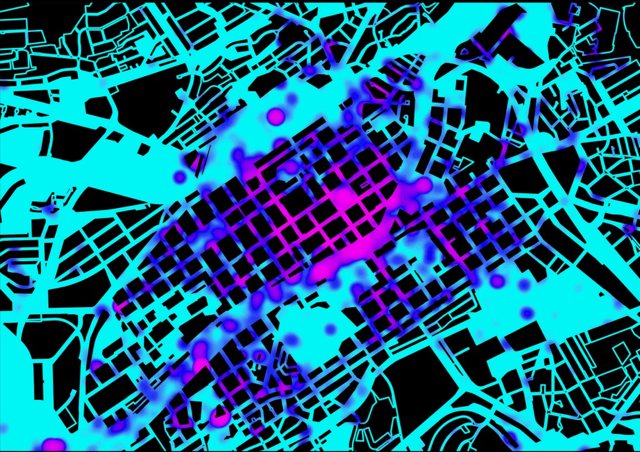
Urban complexity concentrates sharply at Manchester’s core, falling off toward the periphery — MediaCityUK registers as a distinct but secondary cluster.
Comparing MediaCityUK, wider Salford, and central Manchester shows a markedly different Consumption/Leisure balance — MediaCityUK skews toward media/event-driven activity rather than everyday retail and food.
Distributional evenness of activity types across boroughs was used as a proxy for social and economic opportunity, mapped across the whole Greater Manchester region, not just the study area.
Twitter-based temporal patterns are explicitly flagged in the report as summer-only data — a real limitation worth noting before treating any hour-of-day findings as year-round.
Pictures

More space projects

All 61 →
Space
Strelka KB
2017
SPIN Unit · Helsinki — Tallinn
Project record No. 16
Lens:
Space
Reports:
—
The Hidden Life of 38 Cities — World Cup 2018 Heritage
SPIN UnitRead the record →
Space
Strelka KB
2017
SPIN Unit · Helsinki — Tallinn
Project record No. 17
Lens:
Space
Reports:
1
The Hidden Life of 32 Russian Monotowns
SPIN UnitRead the record →
Space
Princeton University
2016
SPIN Unit · Helsinki — Tallinn
Project record No. 12
Lens:
Space
Reports:
1
Rio de Janeiro Olympic Urbanism Maps
SPIN UnitRead the record →
Space
Turku Urban Research Programme
2015
SPIN Unit · Helsinki — Tallinn
Project record No. 11
Lens:
Space
Reports:
1
A Sense of Place
SPIN UnitRead the record →
Space
Sapienza University of Rome
2015
SPIN Unit · Helsinki — Tallinn
Project record No. 10
Lens:
Space
Reports:
—
Colosseum Night Lighting Map
SPIN UnitRead the record →