← All projects/Space/No. 31
2019 · Space · City of Warsaw

Warsaw Spatial Development Scenarios

As Warsaw rewrote its citywide spatial strategy, SPIN Unit joined an international expert workshop to show how mapped social-media activity data could ground scenario planning in evidence rather than intuition.
Warsaw Spatial Development Scenarios

Warsaw was updating its “Studium” — the city’s core spatial development strategy — for the first time since 2006, aiming to curb sprawl and build a more compact, multi-functional city. The planning department invited international experts to help move the process from scenario presentation to genuinely scenario-based planning.

Commissioned as part of a formal, staged workshop process following a May 2018 City Council resolution to prepare a new Studium. SPIN Unit (Damiano Cerrone) was invited alongside partner firm 1=2 Urban Design (Jacob Dibble) for a two-day workshop in January 2019, alongside city officials and other international urbanists.

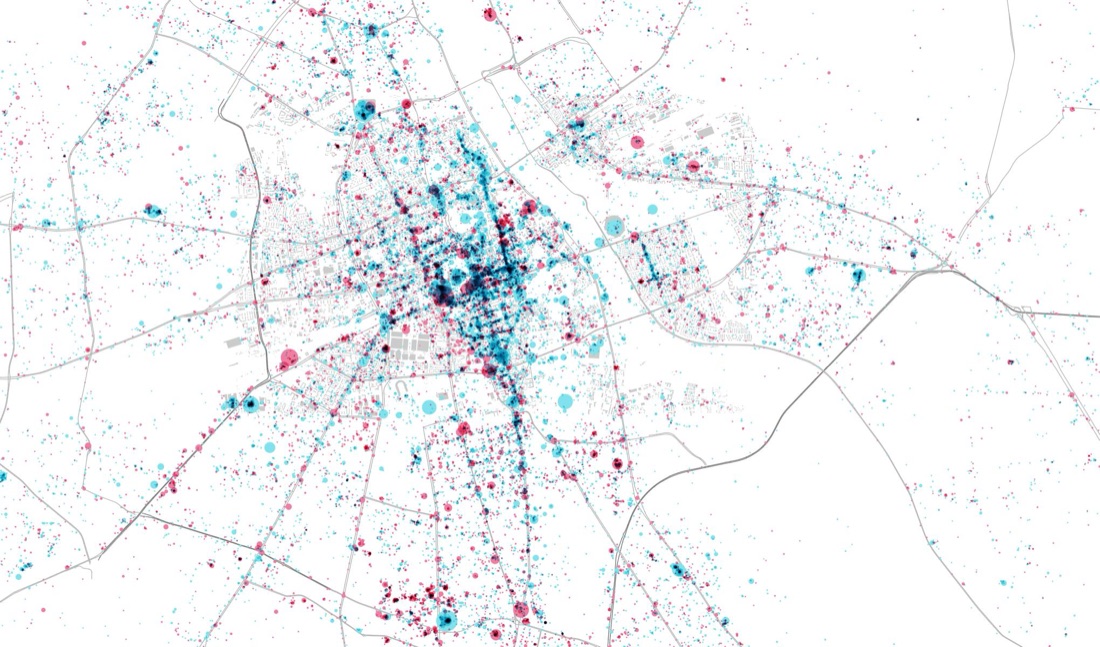
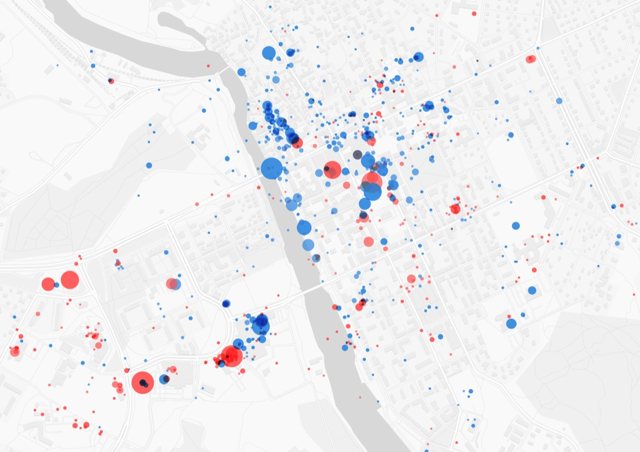
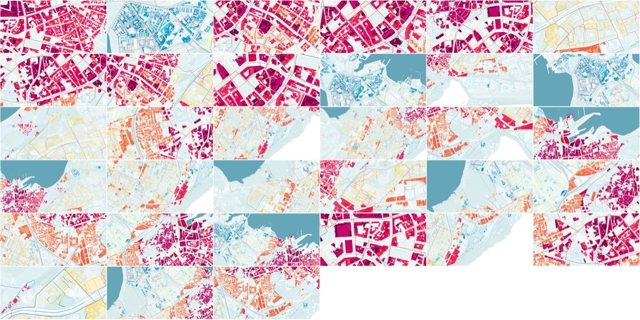
Applied SPIN Unit’s Space/Activities/Values framework to roughly 48,000 Foursquare points of interest across Warsaw, classified into Necessary and Optional activity categories and mapped at both city-wide and street level, to reveal patterns invisible in the city’s existing (extensive but siloed) data.

Delivered as a post-workshop advisory report combining reflections on the two-day session with SPIN Unit’s independent activity analysis.
About the project
ClientCity of Warsaw
PlaceWarsaw, Poland
Year2019
LensSpace
TopicsInternational Advisory, Scenario Planning, Social Media Data
What we found
Activity in Warsaw stretches in long linear strips along arterial roads rather than clustering in central blocks — a markedly different pattern from cities like Helsinki or Turku.
This linear distribution weakens individual neighbourhoods’ identity, since activity bypasses local centres in favour of continuous road-front strips.
Urban block interiors are largely empty of activity across both the centre and periphery — flagged as a genuine, under-exploited opportunity for infill.
Public open space is a real strength: three of the five most-visited place types in Warsaw are outdoor spaces, plazas, or parks — unusually strong compared to peer European cities.
Warsaw’s planning office holds an unusually rich set of data layers, but SPIN Unit’s core recommendation was that these remain siloed and need to be synthesised into a single KPI-driven framework to actually support scenario planning.

More space projects

All 61 →
Space
ALA Architects
2020
SPIN Unit · Helsinki — Tallinn
Project record No. 32
Lens:
Space
Reports:
1
Porvoo Square Benchmark
SPIN UnitRead the record →
Space
City of Tallinn
2019
SPIN Unit · Helsinki — Tallinn
Project record No. 29
Lens:
Space
Reports:
1
metaLINN - Tallinn City Center Development study
SPIN UnitRead the record →
Space
City of Narva
2020
SPIN Unit · Helsinki — Tallinn
Project record No. 35
Lens:
Space
Reports:
2
ReCenter Narva — Youth Vision for Narva 2035
SPIN UnitRead the record →
Space
Municipality of Sipoo
2020
SPIN Unit · Helsinki — Tallinn
Project record No. 36
Lens:
Space
Reports:
2
Nikkilä Colour Analysis
SPIN UnitRead the record →
Space
Gispo
2019
SPIN Unit · Helsinki — Tallinn
Project record No. 26
Lens:
Space
Reports:
5
Vision for Land Use Monitoring — Finnish Ministry of the Environment
SPIN UnitRead the record →