Crime, Society and Urban Design (CPTED)
Does how well-connected a street is — how easy it is to reach and move through — predict how safe it feels or actually is? SPIN Unit, working with the Estonian Academy of Arts, pitched this question directly to the Estonian Police and Border Guard Board.
Grew out of a December 2012 proposal to the Police (“Analyzing the links between urban space and crime — piloting a multi-criteria approach in Tallinn and Tartu”), formalised into a four-phase research plan in February 2014 and backed by a signed EKA–SPIN Unit collaboration agreement (May 2014), with funding support credited to DoRa/Archimedes Foundation and the Estonian Cultural Endowment. Results were presented at an international CPTED conference in August 2014.
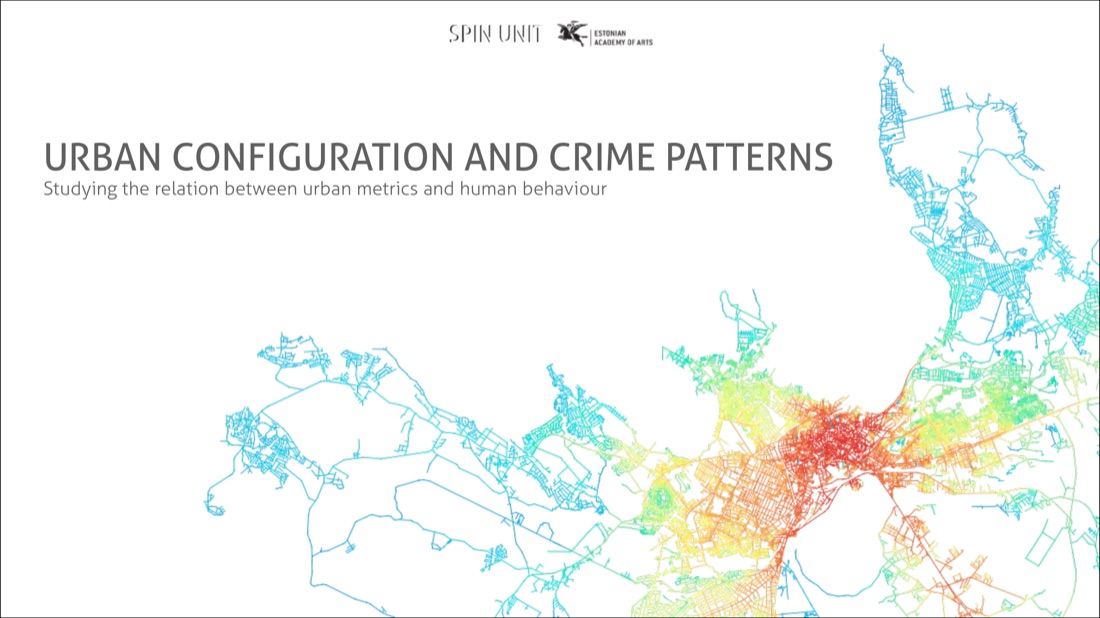
Reused the team’s own custom lighting-sensor rig (built for the 2013 EAEA11 night-map project) to survey roughly 400km and 33,000+ GPS-tagged light readings across central Tallinn. These were compared against a space-syntax segment analysis of the street network and police-reported crime by category (theft, robbery, burglary, violence, drugs, graffiti), replicating methodology from Bill Hillier’s UCL crime/space-syntax research in London.
Only Phase 1 (accessibility and lighting, Feb–Aug 2014) is documented as completed; the planned Phases 2–4 (land use and census data, urban typologies, and a final empirical crime-hazard map with planning guidelines, running through Dec 2015) don’t appear in the project files.
 Open full size ↗