The New Modal — Mobility Equity in Harju County
As smart-city mobility solutions advance, high-efficiency public transport becomes a luxury concentrated in top-tier cities. Harju County — Tallinn plus its surrounding municipalities — faced a growing imbalance: some places could afford smart-city transit solutions, others couldn’t. The challenge was ensuring mobility justice beyond the municipal border of the smart city.
Commissioned by the Harju County Association of Local Governments, delivered with Demos Helsinki, and funded through the EU Interreg Baltic Sea Region Programme’s SUMBA project (Sustainable Urban Mobility and Commuting in the Baltic Cities). Findings were presented at a SUMBA conference in March 2021.
Scored 2,917 public transit stops across Harju County on 19 metrics grouped into two indices — Service Performance (from GTFS data, route delays, passenger counts) and Potential Demand (built-environment and census data, plus qualitative points-of-interest observation) — turning unstructured GTFS data into a regional mobility equity map. 64 stops across 25 locations were surveyed on the ground with spherical panoramic photography and drone flights.
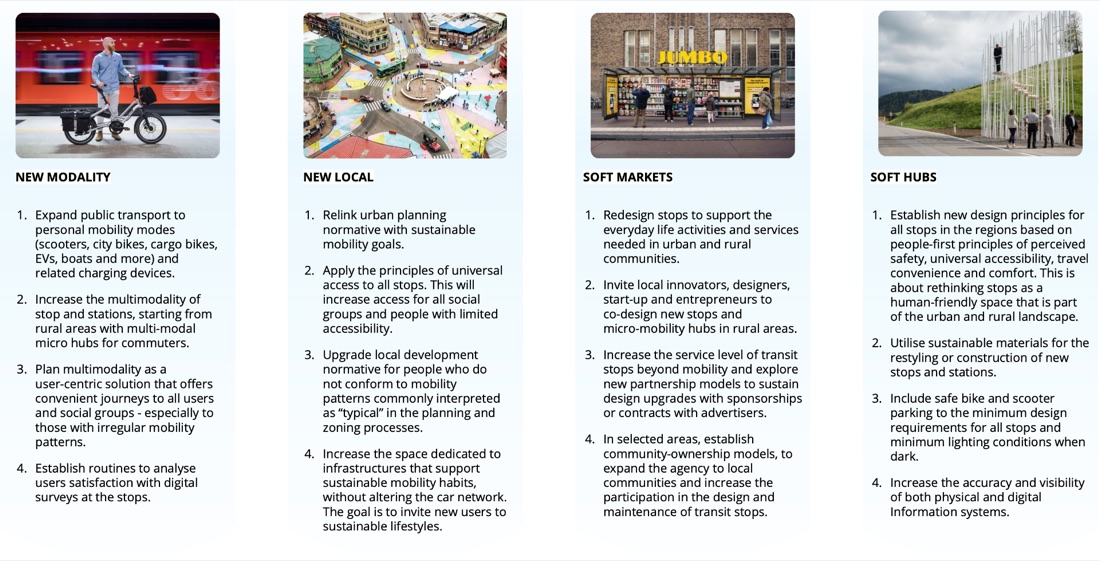
Delivered as a bilingual executive summary, full Estonian report, cartography annexes, and a “Mobility Justice Handbook” of design and policy principles for local place leaders — organised around four ideas: The New Modality, The New Local, Soft Markets, and Soft Hubs.
 Open full size ↗