← All projects/Mobility/No. 60
2026 · Mobility · City of Pärnu

Pärnu Parking Analysis & Strategy

Applying the same rigorous, FANS-framework parking methodology developed for Tartu to Estonia’s third-largest city — finding, again, that the real constraint isn’t public land, it’s private.
Pärnu Parking Analysis & Strategy

Pärnu needed the same clear-eyed picture of its parking supply and demand that SPIN Unit had built for Tartu — but with its own complications: a beach-town tourism cycle, a large share of parking on private land, and a Rail Baltica terminal due to reshape the city within a few years.

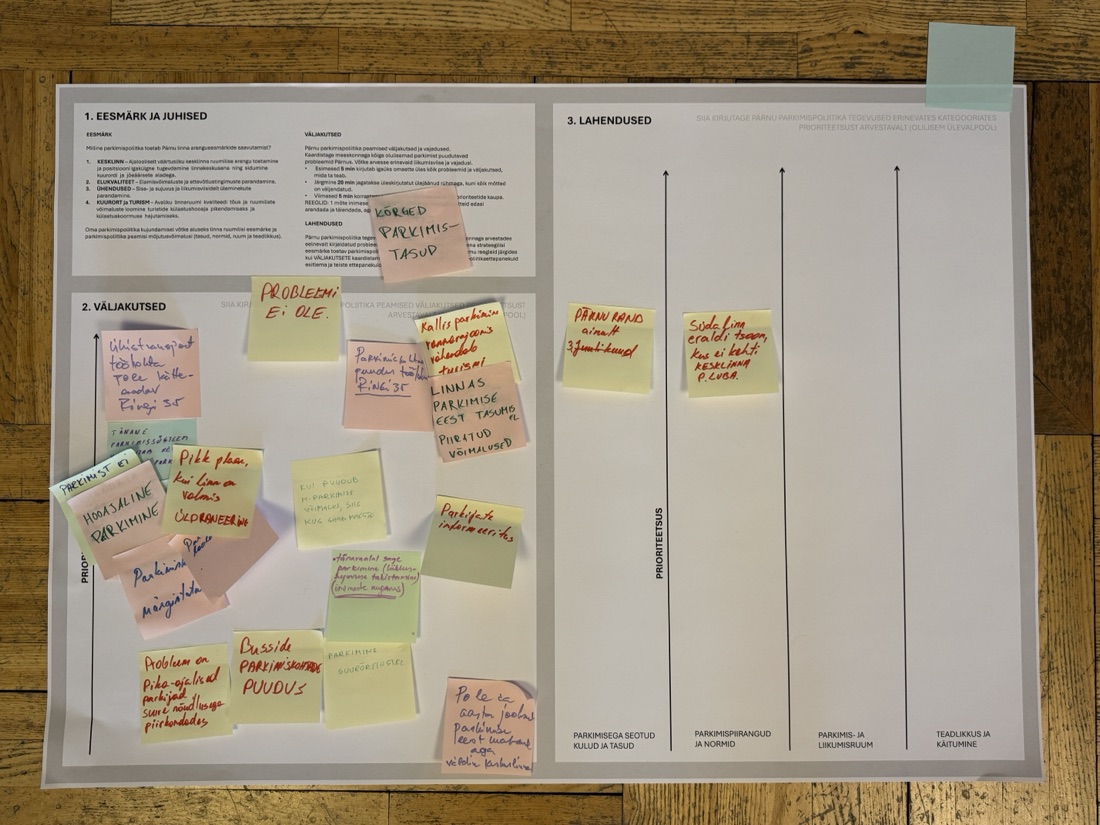
Commissioned via public tender (December 2023), contracted mid-2024, and delivered through a staged process including a stakeholder Delphi workshop in March 2025, concluding with a final presentation to the city council in December 2025. Built on the same methodology and FANS (Fees, Awareness, Norms, Spatial settings) policy framework SPIN Unit developed for its earlier Tartu parking study.

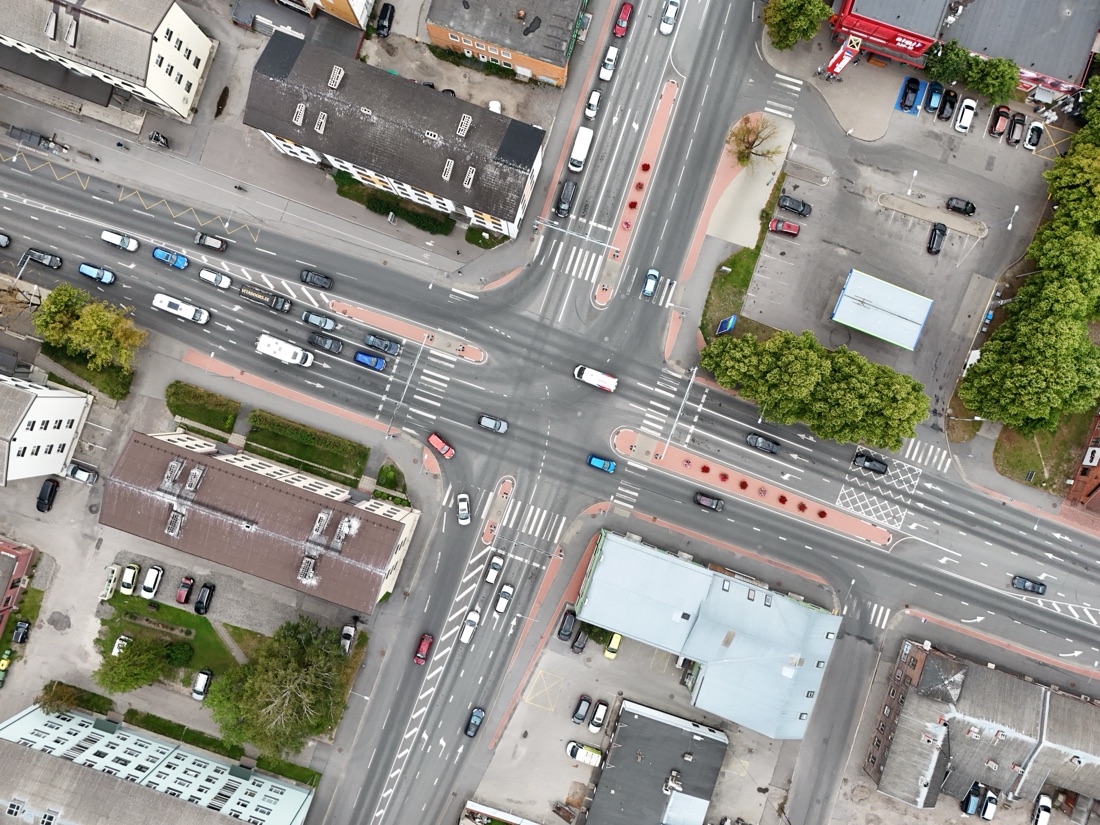
Combined GIS spatial analysis (land use, cadastre, building registry, canopy cover), parking transaction and mobile-payment data, a drone survey of the city, accessibility modelling across seven service categories, and a stakeholder Delphi workshop, benchmarked against the international FANS measures catalogue. Three future policy scenarios — Conservative, Progressive, and Innovative — were developed and scored against the same framework.

Delivered as a full analysis report, a policy recommendations report, an executive summary, and a final council presentation, following multiple rounds of city feedback and revision through 2025.
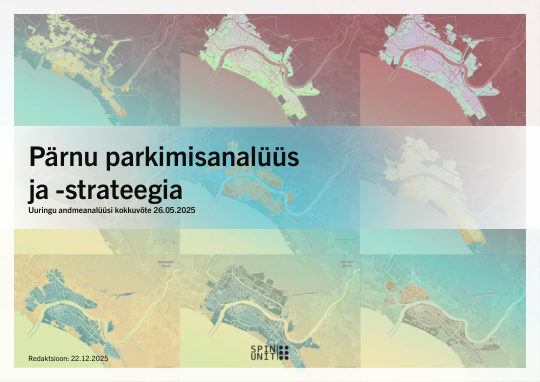
4 reports to download
About the project
ClientCity of Pärnu
PlacePärnu, Estonia
Year2026
LensMobility
TopicsGIS, Parking Policy, Rail Baltica, Stakeholder Engagement
What we found
Pärnu dedicates roughly 107m² of road and parking area per resident, against only about 38m² of net residential floor area per resident — nearly three times more urban space given to cars than to housing.
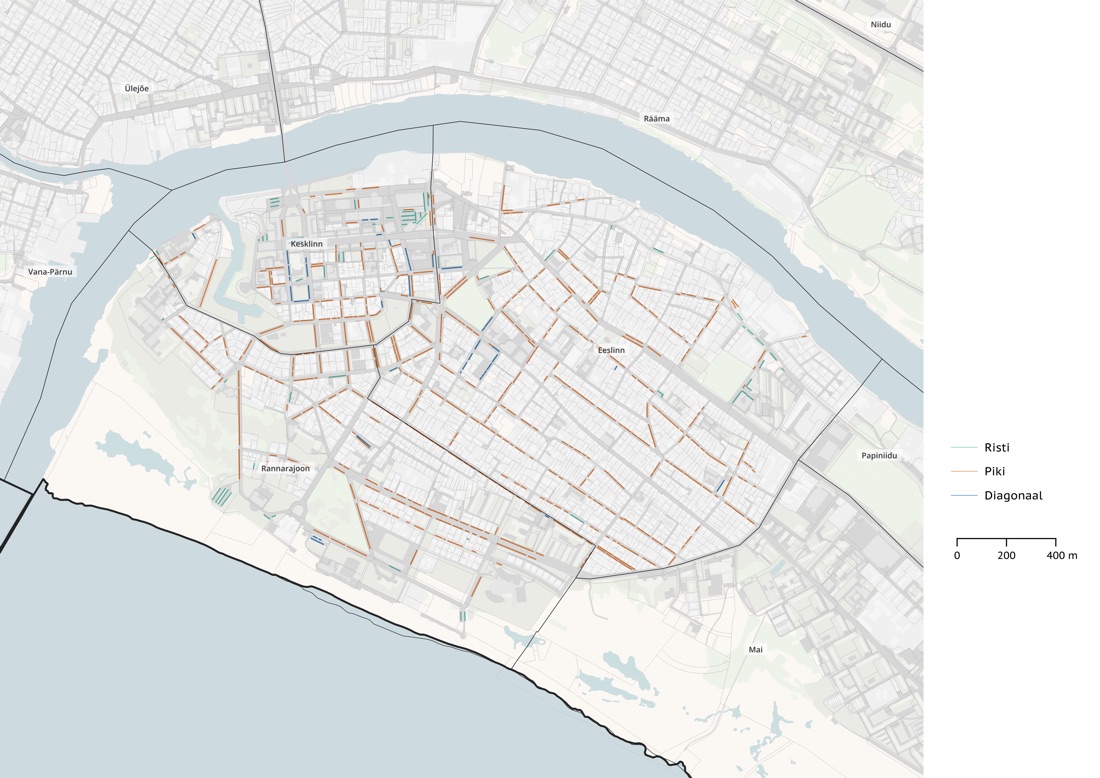
The city’s parking footprint (1.15 km²) is larger than the historic centre itself (0.79 km²) — comparable in scale to what the earlier Tartu study found for that city.
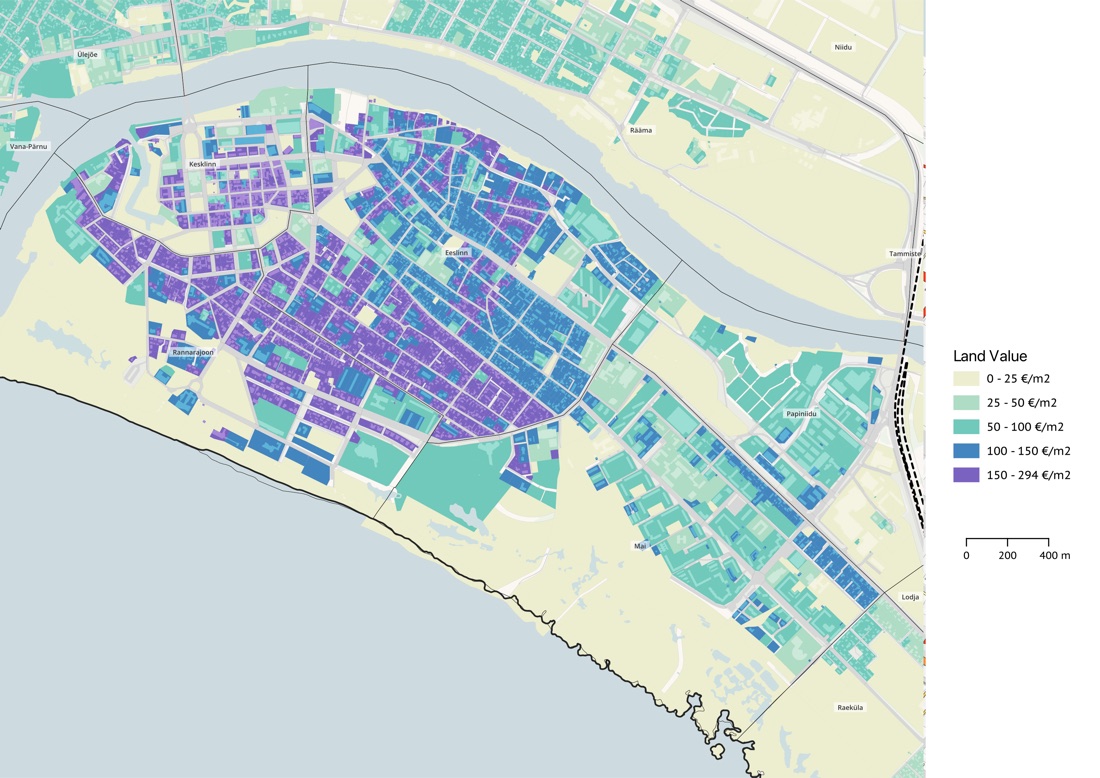
Only about 11% of parking sits on municipal land — 85% is on private land, meaning most effective policy levers require negotiating with private owners and businesses rather than unilateral city action.
No correlation was found between nearby parking supply and business revenue — directly challenging the common assumption that more parking near shops drives more retail turnover.
Residential parking permits spike sharply in summer (341 sold in May versus 54 in April) — evidence permits are being bought as cheap seasonal beach access, not for daily commuting, undercutting efficient turnover in high-demand zones.
The study explicitly built in Rail Baltica’s 2028–2029 terminal opening as a reason to expand paid parking zones pre-emptively, ahead of demand, rather than reacting after congestion appears.
Pictures

More mobility projects

All 61 →
Mobility
Association of Municipalities of Harju County
2025
SPIN Unit · Helsinki — Tallinn
Project record No. 59
Lens:
Mobility
Reports:
3
Winter Maintenance for Walking and Cycling — Harju County
SPIN UnitRead the record →
Mobility
City of Tartu
2024
SPIN Unit · Helsinki — Tallinn
Project record No. 58
Lens:
Mobility
Reports:
2
Tartu Parking Policy Baseline Analysis
SPIN UnitRead the record →
Mobility
London School of Economics
2024
SPIN Unit · Helsinki — Tallinn
Project record No. 56
Lens:
Mobility
Reports:
4
Lebanon Unsettled
SPIN UnitRead the record →
Mobility
Self-initiated
2022
SPIN Unit · Helsinki — Tallinn
Project record No. 53
No. 53
Lens:
Mobility
Reports:
—
Footfall scenarios for a Rail Baltica station development
SPIN UnitRead the record →
Mobility
Association of Municipalities of Harju County
2021
SPIN Unit · Helsinki — Tallinn
Project record No. 43
Lens:
Mobility
Reports:
5
The New Modal — Mobility Equity in Harju County
SPIN UnitRead the record →